- What are Work Modes?
- Any project works in certain set of circumstances and certain set of outcomes in mind. A work mode is how a team works together to make a shared outcome happen. So, every project has mode of working most effectively, reconciling the circumstances and outcomes.
- Any adaptive system operates in different modes. Here are 3 examples:
Example 1: If we take analog of the Human Body – the body re-organizes itself for different modes. There is a steady state mode, a sleep mode, and when you face a sudden crisis, it moves into a fight or flight mode. In the fight or flight mode, the entire body organizes itself for that purpose – adrenaline is pumped through the body, you feel fear & your senses are heightened. It takes up a lot of energy but it is needed at that point in time.
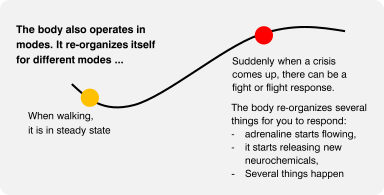
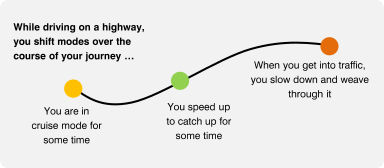
Example 2: Similarly, while driving on a highway, you shift modes over the course of your journey.
Example 3: Football teams operate in modes – The team formations that they take on in order to achieve their goals, is analogous to work modes. The power of a work mode is to sync together and work collaboratively to meet goals. It is situational and contextual.
- Work modes in E&P
- Similarly, in a system like E&P, work modes shift dynamically. Every time there is a shift in ‘priority’ either due to resource allocation or some other reasons, a deeper shift in “modes of work” is expected for a specific team or group.
- Today we are using the terminology “shift in priority” within E&P. But that term does not communicate the richness of the change in mode. People, therefore, are not clear about what is expected of them.
- When we use the word low priority, it means that something is not important, but that is not true. Everything is important. But because of resource constraints or organization decisions, different projects have to speed up and slow down at different times.
- A Quick Walkthrough of the 6 Work Modes in E&P
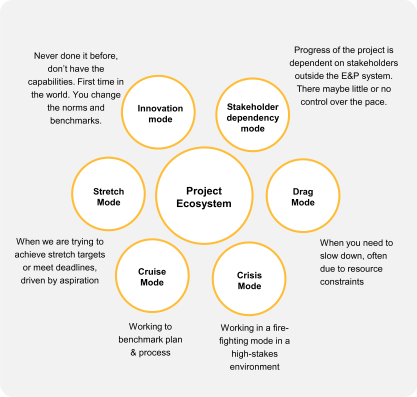
Cruise Mode – you have a plan, you know how many days it will take. Everything is going according to plan. It means you are operating efficiently as self-organized teams. That said, it doesn’t mean that you are operating in a comfort zone/ “time pass mode”, that is not a valid mode in E&P.
Stretch Mode – is when you are trying to meet aspirational targets. The difference between cruise mode and stretch mode is that you are being forced to change your methods of work. Till you redesign your methods of work, you are not operating in stretch mode. You are still operating in cruise mode.
Innovation Mode – it means there is a complex challenge that has never been done before. It is meant to find new answers. It may or may not have space for experimentation. Example – in Apple while designing the original iPhone or iPad, they were operating in innovation mode even though they had 18 months – time to market. But now as they move from iPhone 10 to iPhone 11 and so on, they are not in innovation mode. They are operating in stretch mode or cruise mode. A lot of new product development is in innovation mode when you are trying to reinvent something.
Stakeholder Dependency Mode – when there are lot of variables that are outside your control like government approvals, etc. This means there is a lot of uncertainty and ambiguity. When there is uncertainty & ambiguity, it can sap the energy of the project manager and the team. So it is important to manage it effectively.
Drag Mode – you have been asked to slow down but it doesn’t mean that you have to reduce your intensity. You need to go deeper into the subject and get ready for future takeoff. You try to do those things that do not require resources but require better & deeper thinking. You invest time into building new practices, developing people, etc. which can help you jump into stretch mode and accelerate
You will find very often the project goes into drag mode but the project deadline doesn’t change. Therefore, you have to utilize drag mode as a design mode, reflection mode
Crisis Mode – is when you have to deal with both foreseen and unforeseen crises.
- General Observations on Work Modes in E&P
- Training teams to work in multi-modal formats may improve agility of the entire system and utilize resources better.
- This also means we visualize E&P as a portfolio of projects with different work modes.
- We also expect this to change the nature of engagements and flashpoints that are faced in the interactions between project teams and the support system around them (e.g. procurement, civil).
- Furthermore, one of the challenges we may be facing is that people may be used to working in 1 or 2 modes. They may not know how to work in all the 6 modes.
- How do we signal changes in Work Modes?
- There should be clarity of the current mode
- The trigger for new mode should be identified
- Appreciate why the mode change is necessary
- Decide what’s the target mode
- Mobilize leadership and teams to work according to the new mode