The challenge of integrating the projects view & functional competency view of E&P – the need for an evolved model
- When projects are in crisis mode or are a top priority with dedicated, full-time teams, it is relatively easy & natural to work together seamlessly to deliver a project.
- The challenge is when in a large bulk of projects functions are working across many projects and people are available only part of the time.

- So, in a world where functions are working in “parallel lines”, how to bring them together is the challenge. Earlier the project manager is the only person trying to make it work.

- In this system, the Project Manager was the sole owner of project’s interest, the rest are representing the functions interests.
The Genesis of G6
To improve the integration of functions into projects, the lever used was to create more representatives of the project’s interests in the functions.
Approach to enabling integration of the 2 views:
- Identifying the key dimensions for making a project succeed
- Key dimensions for making a project succeed were identified, so that a wider team which integrates functions and projects can be created.
6 essential dimensions identified were:
- Dimension 1: Shared Visibility (Planning). i.e. ensuring the different parts of the project are operating in a coordinated manner, enabled through real-time communication
- Dimension 2: Decision making (Project Manager). Through-out the course of the project, there are decisions to be taken.
- Dimension 3: Flow of drawings is essential
- Dimension 4: Flow of materials is essential – i.e. supply chain management. Equipment and Structural Manufacturing are an input to this.
- Dimension 5: Construction
- Dimension 6: Assurances – there are technical assurances – quality & safety and budget & process compliance assurances.
Creating a wider ‘G6’ team (around the 6 dimensions) to collectively own the project
- The 6 dimensions became the basis for a wider project team called the ‘G6’. The G6 includes not just the Project Manager but also 5 representatives of the key dimensions of the project.

- This configuration extends representatives of the projects interests into the functions.
Every DU has a G6 Team
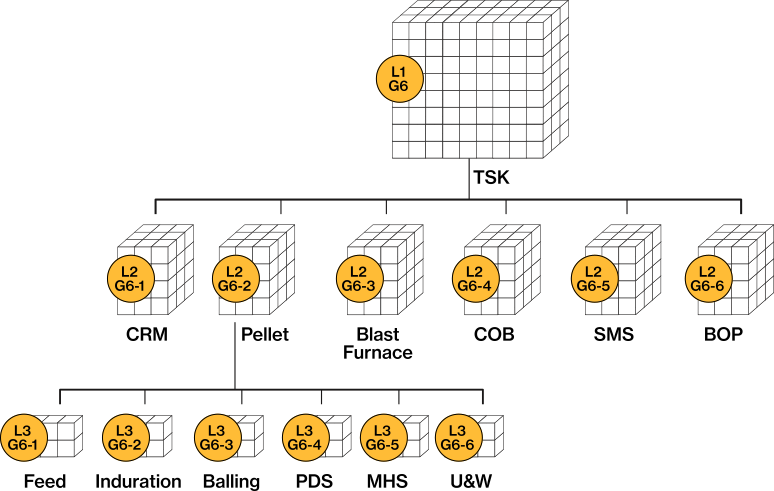
- Every DU is individually & collectively owned by a “G6”.
- The nested structure of the project maps on to a nested structure of G6. E.g. A project with 5 levels of DUs x 6 DUs at each level will have 30 G6s.
- A person may be in more than one G6. So G6 members may be full time or part time.
- Same person can be in 2-3 G6, depending on the workload. There is a job to be done, he goes and plays that role. We are used to role = position = person. But there are only so many resources. So a person can play many roles.
- Each member of the G6 must be from the respective function and must have credibility in his functional team to be able to pull resources.
- Ownership of a DU is given based on a person’s competence for owning a DU rather than one’s position.
- At the lower levels, the DU need not be owned by only Tata Steel employees, depending on who has to complete it, it can be owned by contract resources as well.
G6 is the owner of a “zone of responsibility”
- One G6 has one zone of responsibility. If you take TSK G6, it has a huge zone of responsibility. That is being taken up by 6 smaller zones of responsibility. Each of those is being taken up by 6 smaller zones of responsibility.
- It is not a hierarchical organization any more, we are looking at it as zones of responsibility. Each is zooming in.
