The Planning Dynamic
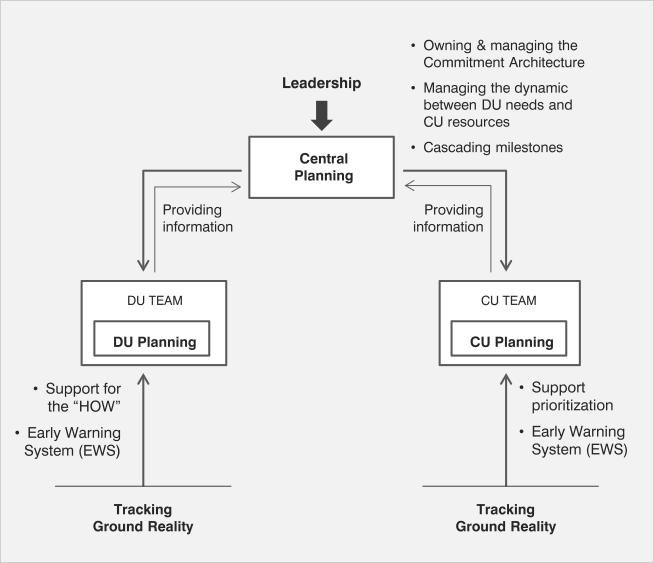
- Central Planning owns and manages the commitment architecture (which may have been defined in P1 and evolves over time). It also manages the dynamic between DU needs and CU resources. Also, over the course of the project in case work modes changes, central planning is dynamically aligning project deliverables and resources and this is cascaded down on the DU side and the CU side.
- There is also a reality playing out. That needs to be tracked.
- DU Planning’s role is – (i) Also, they play a support/ advisory role by providing more optimal execution pathways (HOW) (ii) It is also tracking what has been achieved on the ground, and based on that showing potential flashpoints and providing an Early Warning System (EWS).
- Similarly in CUs, planning – (i) enables optimal prioritization (taking a cross-DU view), (ii) provides an early warning system
Bringing a Self-balancing dimension to the system
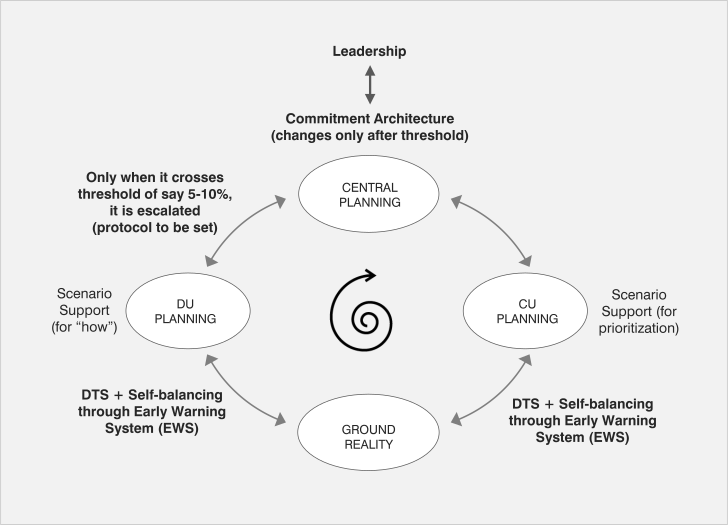
- If there are small variations to plan, the CU planners and DU planners are to i) provide Early Warning , ii) work with the teams, give them alternative project execution options so that self-balancing takes place and it doesn’t change the commitment architecture.
This is a case of DTS for negative self-balancing (in case of a failure or delay, they need to catch up and self-balance so it doesn’t change the commitment architecture).
- Teams can also set aspirational Dare to Succeed (DTS) goals (i.e. team is proactively figuring out how to get things done faster and better).
- The implication is that across the system, in every team, there is a space of freedom to i) self-balance, so we stay on course and ii) create a positive benefit which can be shared between the organization and the team.
- Only after a certain threshold is crossed (+/- 5 to 10%), it will be escalated to Central Planning. Only after approvals from the leadership, the commitment architecture will be changed. The threshold points and the protocol for escalation are to be designed.
- If the G6 teams are escalating too many times, it means G6 teams and CU teams are not doing enough to figure out answers to address the problem and course correct. It means self-balancing is not taking place.