- Definition of DUs (snapshot: whole sub-system boundary, value, impact/ consequence)
- List of G6 teams
- Budget & time estimate (this covers the delivery schedule)
- DU may have different “work modes” across phases – if so, it needs detailing accordingly (e.g. one part may need to work in shutdown)
- Work Method to be clarified (needs execution visualization)
- Different options to be considered, evaluated & one to be decided (how we believe we can do things differently)
- Narration of how project will unfold on a timeline to meet the commitment
- Potential hotspots & plan to deal with them
- Dare To Succeed Process
- Resource requirement detailing (people, equipment) from each function in terms of total time required and when it is needed, mapped to a calendar – this will reveal resource hotspots, and help think about how to handle critical resources that are enablers in many projects, etc.
DUs are defined based on the following criteria –
- Whether it is a whole value creating unit or not
- Capex Value is one criteria
- In other cases the value maybe less, but it maybe high impact.
E.g. A shutdown for BF was such, that the cost of the project was not even 1 crore, but a delay of 1 hour could cost the organization 100 crores.
- There could be geographical point of view – sometimes it has to go outside the plant cross railway lines, etc. or water for slime disposal needs to be brought from the river.
E.g. There is stretch which is 500m of railway line connectivity. The value may be only 5 crore, but we haven’t been able to complete it for 5 years. For the 0.3 or 0.5 acre, there are 4-5 IL2s who are engaged.
G6 members are identified based on the following criteria:
- Has relevant project experience?
- Context of project (prior experience)
- Ability to handle this level of responsibility (Can handle project size/ cost?)
- Can handle the criticality/ complexity? (consequence of failure)
- Engagement & synthesis capability
- Role owner (vs. Task owner)
- Broad T-profile: broader understanding of multiple related functions
- Use it as a career development move
- Personality criteria
- If people are very individualistic, they may not take a collective success view
- they must be reasonably open minded to change (change from older functional specialization to broader view)
- make it happen mode, proactivity & follow-through approach to work (getting it done)
- attitude of positive engagement (not complaining or seeking resources)
The commitment map should have a quick snapshot covering
- Time (duration and when the delivery schedule is)
- Budget/ Cost
- Impact on the top line or bottom line
E.g. Pellet plant has been put on stretch mode because it is giving 1100Cr. impact per year on the bottom line, while CRM is impacting the top line.
The importance of identifying work methods
Developing the Commitment Map, gives us an opportunity to revisit and improve the work methods. This in turn helps us find new levers of efficiency and allows us setup new benchmarks, rather than repeat past performances.
Practices for generating alternate work methods
Some practices that were identified were:
- Benchmarking: benchmark against the best to improve
- Setting aspirational targets: ask why it cannot be done, say, in half the time
- Identify zones of inefficiency: find areas where you can create efficiencies. These add up to create a bigger efficiency.
- Zero-based budgeting (rather than historical): rather than depend on past data
- Design Teardown and re-construction is another method. This allows for quantum jump (e.g. converting welded to bolted, autonomous EOT crane). ADC, for example, enables design teardown.
DTS Process
(a model to drive innovative ways to get things done faster, at lower cost, improve quality, reliability)
We are looking at the scope for innovating in our method so that we can improve on that stretch (with a step change). But, we don’t want to just stretch further. Instead, we want to change the way things work and thereby get completely new value out of the system.
Example 1: In construction, we are reviewing how we can do 15,000 in a month. In the current approach, it means 500 lifts. Another option is we ask ourselves, “Can we convert 500 lifts into 250 lifts? Can a lot of height work can be brought to the ground?”
Example 2: 36 galleries would take 4 months to do. By distributing it to different ecosystem partners it can happen in parallel. So, the same job is being done in 1.5 months.
Therefore, DTS aims at generating innovation value not stretch value. Also, it is not about the top DU driving it, but about institutionalizing collective innovation. So, it has to be driven by each team.
DTS done well, will lead to new work methods and will automatically shift the benchmarks for the project.
Explore details of how DTS works
Detailed Execution Visualization for Shutdown Projects – what is expected
Step 1: In such high impact jobs, first, the per-hour impact should be calculated.
Step 2: This should be followed by a detailed planning & visualization. It is a pre-mortem looking at what can fail, what is the impact of failure and what is the mitigation plan we are putting in place if we cannot eliminate those risks.
If the shutdown is a 37-day project, it should have 37 sheets (Day 1 – Day 37). The planning sheet for each day should cover the following:
- Each day is broken into 2-hour slots and there needs to be resource mapping for each activity. It will mean 12 rows from 8am to 8am.
- For each 2 hour slot, the following will need to be identified –
a) activity being done, b) who will do the activity, c) resources required – in terms of tools, tackles and equipment, d) requirements from a quality & safety perspective.
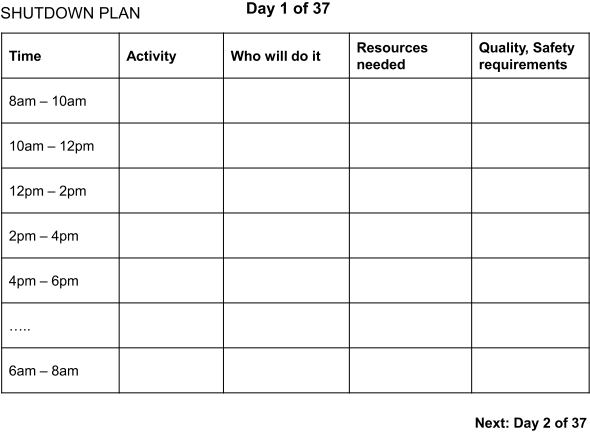
This will help understand the linkages with preceding and succeeding activities, the potential bottle necks, resources that are critical, and what alternatives we have. This is crucial because in many cases the impact of the delay can be huge, say 100 cr. per hour in shutdowns.
E.g. One of the critical resources is a Crane. What are the fallback options we have considered? These options need to be worked out and the consequences need to be taken care of. In this case, if we decide to have another 200-ton crane as a backup, the next question is, “how much we are utilizing the 2 cranes?”, because it is the most important resource. So we need to plan the activities accordingly and also need to facilitate the use of a crane by building the road for it, materials, etc. So, every time we do something to take care of one constraint, it opens lots of other aspects to be taken care of as well. The challenge is how do you shift the critical path to get the best out of the situation?
Step 3: Also, for each activity the pre-requisites can be identified. For example, it can be in terms of the engineering availability, carrying out a construction simulation to check various aspects, etc. For example, when in P3, if while loading up a crane we find it is over capacity, then work comes to a stand-still and precious hours can be lost in finding a solution. This can be prevented if a simulation is done during P1.
Step 4: Further a simulation/ visualization can be done of how multi-work will happen in parallel, what will move where, etc.