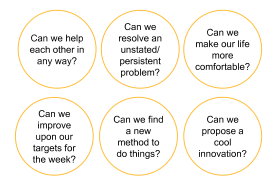
A model to drive innovative ways to get things done faster, at lower cost, with improved quality, reliability
We are looking at the scope for innovating in our method so that we can improve on that stretch (with a step change). But, we don’t want to just stretch further. Instead, we want to change the way things work and thereby get completely new value out of the system.
Example 1: In construction, we are reviewing how we can do 15,000 in a month. In the current approach, it means 500 lifts. Another option is we ask ourselves, “Can we convert 500 lifts into 250 lifts? Can a lot of height work can be brought to the ground?”
Example 2: 36 galleries would take 4 months to do. By distributing it to different ecosystem partners it can happen in parallel. So, the same job is being done in 1.5 months.
Therefore, DTS aims at generating innovation value not stretch value. Also, it is not about the top DU driving it, but about institutionalizing collective innovation. So, it has to be driven by each team.
DTS done well, will lead to new work methods and will automatically shift the benchmarks for the project.
How DTS works:
Principle of cascading improvement that creates a positive energy in the system
It starts with the highest DU giving a ΔDTS by identifying innovations.
Then each level of sub-DU has more granularity and can bring in micro Δs into it. So the sigma from top to bottom is much more.
Here, each subsequent DU is trying to better the other in the innovations they come up with – by asking “Can we?” It is supposed to create a positive energy in the system – of ‘dare to succeed!’ It is an atmosphere of innovation and experimentation.
To elaborate:
- Beyond the commitment to board, the highest DU through some innovations at the top level can propose a dare-to-succeed Δ (DTS) ‘Target – ΔDTS’ to the sub DUs: Using this, say, a stretch target of 15th January can be advanced to 24th December. Δ (DTS)
- Looking at this date, each Sub-DU team will ask themselves what is the element that we can potentially surpass? What can we put as our DTS number? Sub-DU decides to challenge that with some innovations in their ways of working. This advances the target to say – 12th December.
- Further, the next level tops that with another ‘ΔDTS’. This advances it to 24th November, and so on.
- The G6 member works with his/ her CU to identify innovations. The CU members help may give a better answer on how it can be done differently.
Workshop Model: To address execution visualization, DTS innovation and anticipation of scenarios
- In the beginning, instead of setting DTS with a blank slate (which may be difficult to start with), we can setup DTS in relation to ‘Blue Spaces’ & ‘Red Spaces’ in the project.
- Blue Spaces are those specific areas where we can do things differently and get significant savings. For example a blue space could be: “how can we get the structural material as early as possible?”
- Red Spaces are those potential scenarios where things can go wrong, how to deal with them. This is about anticipation.
- We could ask the group: What are the 7-8 blue spaces and 7-8 red spaces we want to identify? With this, the big things that can go wrong and the big things that can be improved can be worked out.
- For anticipation, every 15 days, the teams can hold “Can we” meetings.
Method for DTS: Identifying Blue Spaces & Red Spaces
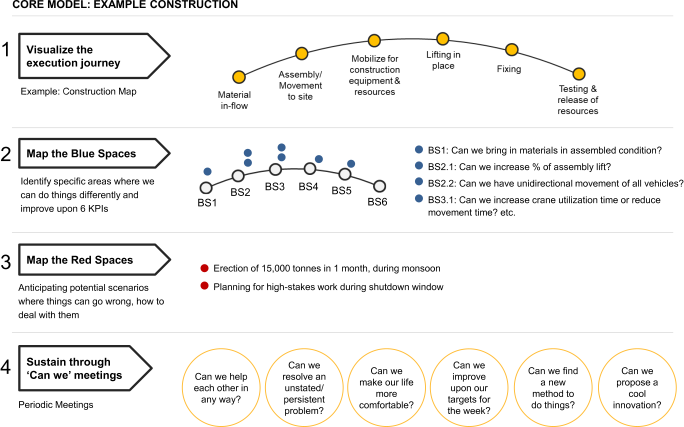
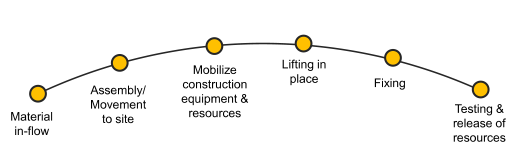
STEP 1: Visualize how the execution journey unfolds
Each group can map its execution journey. It was found that any construction execution journey was as follows.
[general framework that can be interpreted for all construction –
i) civil, ii) mechanical: structural, equipment & piping, iii) electrical instrumentation & control]
STEP 2: Map the Blue Spaces
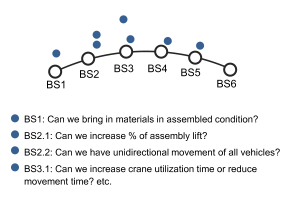
Identify specific areas where we can do things differently and improve upon 6 KPIs (strategy options can be created at each point on the map).
New Strategy options are generated based on:
One, Commitment, impact of the job and the work mode:
Example 1: If it is in stretch mode, then we could consider use a 1250-ton crane for a single lift, because it is a high value/ impact project.
Example 2: Stove 4 is an example. The impact is crores per month. We would like to do something that is round the clock, but we don’t want that one person is working for 8-hours continuously. The solution identified was that welders work in pairs. One person works for 2 hours, rests, while the other takes over for those 2 hours. In this way maximum productivity is achieved.
Example 3: Work mode can also impact the supply strategy. For example, while just in time is preferred, in a stretch mode, it shifts to well in time to reduce risk. Potential Hidden Failure: Communication of supply strategy to all stakeholders based on work mode.
Two, Constraints on the ground for construction – for the specific DU/ job. For example, there may be some existing structures.
Some Examples of multiple strategies:
Depending on the requirement of the project, the work mode, the value/ impact, cost, the decision can be made.
Eg1: We want to get bolts at site. There are choices: Whether to get it made locally, or get it from Calcutta. Further, raw material could be bought by us, vendor fabricates. Or both can be done by the vendor. Another option is that raw material, fabrication and erection can be done by the vendor. Therefore, there are several permutations and combinations.
Eg2: If 10 bolts are getting manufactured every day, should they be dispatched separately so that it is available every day in the work front? The fallout is the trailer is loaded only 1/3rd. So the cost will be 3 times. Should it be brought by train? Or should it be air lifted?
Eg3: For fabrication, there can be a spectrum from full in-house to fully bought out. Also within fabrication, for every activity there can be choices – e.g. machining, welding, etc. Within fabrication, for each type – bolts, technology, structural, equipment – there will be choices. It is a simple decision tree.
STEP 3: Map the Red Spaces
Anticipate potential scenarios where things can go wrong, how to deal with them.
Some examples:
- Erection of 15,000 tonnes in 1 month, during monsoon
- Planning for high-stakes work during shutdown window
Pre-requisite: For each DU, there should create construction approach notes which describes your strategy and why that strategy is being followed.
This is the Blue Space/ Red Space Method that can be used for generating options for DTS and anticipating scenarios.
STEP 4: Further, this can be sustained on an ongoing basis in ‘Can We’ meetings.