D&E has Functional Engineering, Product Engineering, Process Engineering and Engineering Manager. The 4 phases were considered and teams were identified.
Goal: How can we group it into meaningful teams so that we know if we have enough people with capacity to deliver to match the project requirements?
Visioning Phase Teams
All the deliverables of these 4 functions in the P1 Phase were seen together.

The frequencies of these deliverables were mapped.
- Some were done once in 5 years e.g. Master Plan is done once for each location [C]. We can have some experts for that.
- [B] deliverables are those which are one time, but done for every DU. E.g. Project requirements, effort estimate.
- [A] deliverables are ongoing. E.g. Mapping expectations with stakeholders, Engg. Change Management, etc. This will need a full team for the engineering manager.
It was found that the functional, process and product engineering teams work on DUs (see B deliverables) i.e. they are cellular teams which work on one DU, moves to the next DU, and so on.
So a Visioning Team in functional engineering, say, must have the competence to deliver all the 3 of the above [B] deliverables for any DU. They are the team competencies. If we think in team competencies, we can then work out how many such DU teams are required. We can calculate the man months for each and add it up and finally get a figure of, say 200 DU team months. That is your capacity. Similarly in product engineering and in process engineering.
So you have Visioning Teams with a set of competencies working across DUs.
Specification Phase Teams
Deliverables were grouped into 3 types: i) Design/ knowledge intensive, ii) Detailing intensive, iii) Synthesis/ Engagement intensive.
For Detailing, there are people available in the market – that is where we can buy it out. But in the case of Design/ knowledge intensive and synthesis/ engagement intensive deliverables, there is a gap.

Also it was noted that Detailers, Designers are specialized – also there are sub categories in each type of engineering in which they work. They cannot shift from one to another. As a result it was organized into grids.

- On one axis we have project competencies / orientations – i) Design/ knowledge intensive, ii) Detailing intensive, iii) Synthesis/ Engagement intensive. Also, we have specialization areas in Product, Functional and Process Engineering that people can develop in.
- In Functional Engineering we have – Civil & Structural, Mechanical, Electrical.
- In Process Engineering we have – Iron making, Agglomerates, Coke & BF, Steel making and Line, Long product rolling, flat product rolling.
- In Product Engineering we have – Bulk Material Handling System (e.g. slag car, crane, transfer car), Moving Equipment & Static Equipment (e.g. tanks, pressure vessels, BF shells, containers).
- It was established that a person can grow into BMHS in his career – it is a valid/ possible capability building block.
- Specification Teaming model: Each cell is a capability building block (which a person can grow into over 15 years) and each capability building block can be manned. This is the cellular team structure in this phase.
- The tactical leader becomes the CU Leader who takes ownership for a capability block.
- We can use this to tag people – who can do what, and know where gaps are. We see how many are in each category and what is your demand-supply across DUs.
Implications on Career Development in D&E
- In D&E, three kinds of career paths – A, B, C – were identified. MHS for example, has 30 sub blocks. IL6 to IL5 – You move from one sub block to another within MHS. A person should become an IL3 only after s/he has moved at least 3-4 sub blocks within MHS. From an organizational point of view, it will take at least till an IL3 to get mastery of a block.
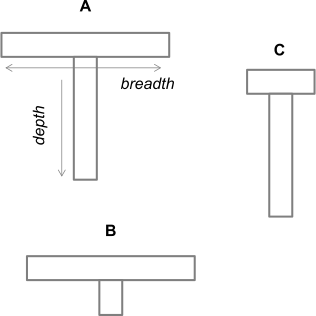
- After a person has mastered a block, you decide which career path to move them into. If they have proclivity to get a full view, move them to career path B and so on.
- At IL levels, in the technical zone, it is not about expertise or years, but about how much they can own totally. If someone can own one block that is a whole product, then he is a value creator.
- If a person is owning a very small area, but going deep, treat them differently as an expert (Path C). E.g. There are specialists – refractory, hydraulics, etc. they can be inside E&P or on the outside. Out of the 20 things, we may outsource 15. But 5 which are our core, we may like to own. For example, many of the troubleshooting roles, which we have as a service this becomes important.
- So, you have different Specification Teams/ Cells. Each may have 2/4/5 members depending on the work. Each cell should be given the deliverable, not a person. In the cell, that is how people will grow and get a holistic picture of the product.
- It was also established that same teams will work on P0 and P1. And similarly, the same teams which did P2, will do the engineering change management in P3, P4 phases.
Implication on Managing Resources in D&E
- Today we move people from P1 to P2 or the other way round if they are free, so we can load them. Instead of having too much movement of people, it is better to grow a cell i) It is easier to manage and ii) for them also it is a meaningful journey.
- Allotting persons to P1 as growth/ development opportunity: P1 expands the horizontal (of the T) of the person/team. You get an end-to-end picture. When you want to widen the T, move a person to P1. So when you want to grow someone, move them to P1. P1 is a higher status.
- Implication on Standardization: These “cells” are the unit for repeatable items. All repeatable items should use this architecture.
- Create a maturity curve for each block: For each block we can create a growth map – build basic competency, get into standardization, create scalability.
- Each “block owner” (CU Leader) is responsible for standardization.
- So these, ~42 CU leaders (block owners/ tactical leaders) are needed to be built first. They will tell you what team they need etc. Some we may have in-house filled by us, some maybe consultant/ partner depending on criticality/ complexity.
- Agility within the blocks: P0 – P1 people can be clubbed as one. They will be allocated to projects. The leader will dynamically use them. So there is agility, but at a micro level.